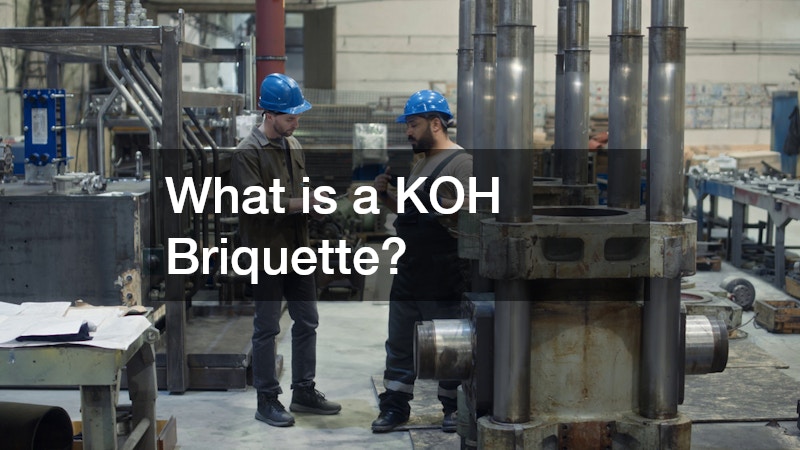
How are KOH Briquettes Produced?
KOH briquettes, also known as potassium hydroxide briquettes, are produced through a meticulous process that involves pressing high purity KOH into a solid form. The raw materials include potassium hydroxide flakes or pellets, which are moistened slightly to aid in compaction. Typically, a hydraulic press or similar equipment is used to apply high pressure, forming the briquettes into their final shape. This process not only ensures that the briquettes are compact and sturdy but also reduces the dust associated with loose KOH, making handling safer and more efficient. The resulting briquettes are then dried and packaged for distribution and use across various industries.
The precision in the manufacturing process guarantees that the briquettes maintain a consistent shape and density, which is critical for their functionality. The production environment is carefully controlled to ensure purity and consistency, which are paramount in applications requiring high-quality KOH, such as in laboratories or industrial processes. The compact form of the briquette allows for easier and safer storage compared to loose powder or flakes, minimizing the risk of spillage and accidental exposure.
What are the Key Composition and Properties of KOH Briquettes?
The composition of KOH briquettes is focused primarily on potassium hydroxide, with the purity of this compound playing a pivotal role in the quality of the briquette. The chemical formula for potassium hydroxide is KOH, and it is a potent base that is highly soluble in water. In its briquetted form, KOH retains these properties but offers enhanced safety and ease of use compared to the powdered or flake forms. As a drying agent, KOH briquettes are highly effective, absorbing moisture from their environment, which is crucial in industries that require low humidity conditions. Furthermore, the briquetting process increases the material’s density, allowing for a slower dissolution rate, which can be an advantage in controlled applications where a gradual release of potassium hydroxide is desired.
Physical properties such as the hardness and uniform shape of the briquettes make them ideal for automated processes where consistent size and form are necessary. The even compaction ensures that each briquette contains a consistent amount of active ingredient, which is critical for accurate formulation in chemical processing and manufacturing. Additionally, the briquettes’ increased resistance to mechanical breakdown during handling and storage minimizes product loss and contamination. This ensures that both small-scale and bulk operations can rely on the integrity of the briquettes throughout their supply and usage cycles. Notably, the robustness of KOH briquettes facilitates a lower overall cost of production by reducing waste and optimizing resource allocation.
How do KOH Briquettes Differ from Other Briquettes?
When comparing KOH briquettes to other types, such as charcoal or bio-briquettes, their chemical nature and intended use are starkly different. While charcoal briquettes are primarily used as fuel, KOH briquette suppliers know they are not intended for combustion but for their reactive chemical properties. The manufacture of KOH briquettes focuses on achieving high purity and minimal impurities, critical for applications that require precise chemical interactions. Furthermore, the physical properties, such as hardness and solubility, are tailored to meet industrial needs rather than for calorific output as in fuel briquettes. Therefore, KOH briquettes are positioned firmly in the realm of chemical and industrial applications, contrasting the energy-focused use of other briquette types.
The durability and density of KOH briquettes also set them apart from other non-combustible briquettes, such as those used in water treatment or metal processing. For instance, in water treatment, briquettes may need to dissolve quickly and uniformly, whereas KOH briquettes are designed to release KOH at a controllable rate for effective industrial or laboratory use. This slow-release capability is key in industries such as petrochemicals and pharmaceuticals, where precise dosing is required. Moreover, compared to mineral briquettes, KOH briquettes contribute significantly to adjusting pH levels in processes needing high alkalinity, which demands specific chemical properties not associated with many other briquette types. Therefore, the unique formulation and purpose of KOH briquettes allow them to fulfill roles that other briquettes simply cannot.
What are the Applications and Uses of KOH Briquettes?
KOH briquettes are widely used across various industries for their chemical properties rather than their energy content. One of the primary applications is in the chemical industry, where KOH acts as a precursor to many potassium-containing compounds. The controlled release of KOH from briquettes makes them suitable for processes like saponification, where gradual addition of the alkali is beneficial. This property is advantageous in the manufacture of soaps and detergents, where consistent product quality is essential. Moreover, in the pharmaceutical industry, KOH briquettes are utilized for neutraceutical applications and as intermediates in drug synthesis processes.
Another significant use of KOH briquettes is in agriculture, where they are employed to produce fertilizers and plant protection products. The high potassium content in KOH makes it an excellent candidate for manufacturing potassium solutions that improve plant health and yield. Additionally, the briquettes’ role in adjusting soil pH levels is crucial in modifying the soil chemistry to suit crop-specific requirements. This versatility in agriculture showcases KOH briquettes’ contribution beyond mere chemical reactions, aiding in sustainable farming practices and improving food security. The controlled application of KOH via briquettes ensures that the nutrient release aligns with plant uptake needs, enhancing crop efficiency.
In the industrial sector, KOH briquettes are instrumental in processes such as electroplating and metal finishing, where their alkalinity is leveraged to condition metal surfaces. The briquettes are used to create solutions for etching, cleaning, and refining metals, facilitating efficient surface treatment. They’re also valuable in the biodiesel industry, where KOH is a key component in the transesterification process to produce clean-burning fuel alternatives. Here, the consistent quality and ease of handling of briquettes support large-scale production and sustainability initiatives. Thus, across diverse industries, the applications of KOH briquettes demonstrate their adaptability and vital role in modern production and manufacturing.